
What a Tysons Digital Marketing Consultant Does
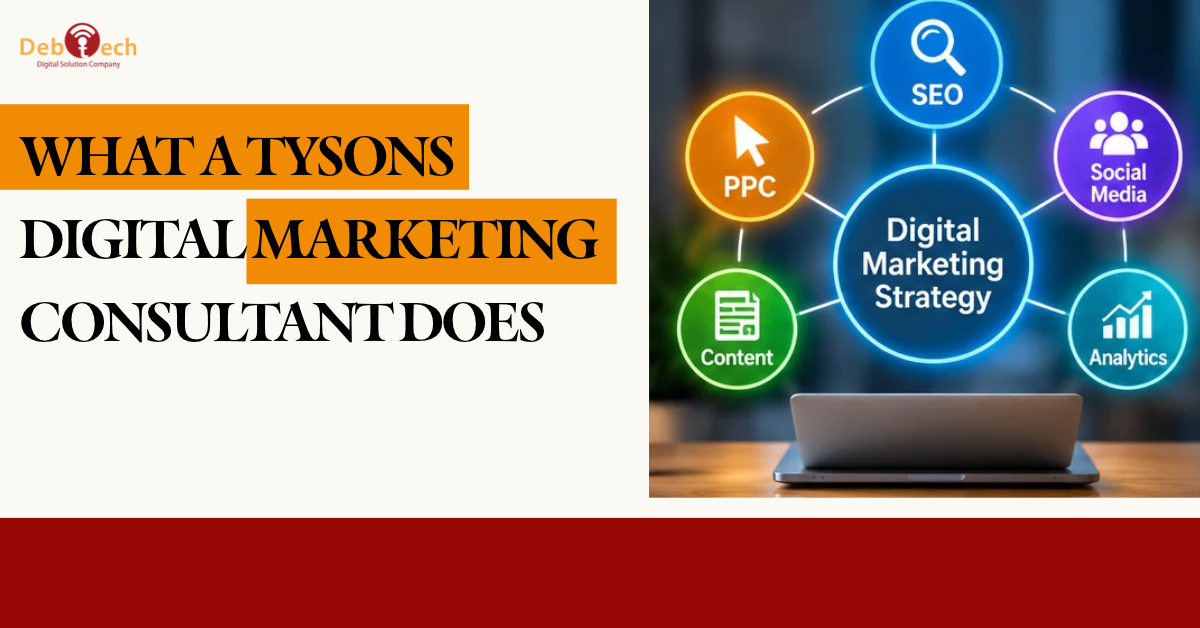
A business can spend heavily on a new website, paid ads, social campaigns, and search optimization yet still struggle to generate qualified leads. The usual issue is not effort. It is disconnected execution. A Tysons digital marketing consultant helps bring those moving parts into one revenue-focused plan, so every channel has a job, a measurement standard, and a clear connection to business growth.
For companies competing in Tysons and the wider Northern Virginia market, this matters. Buyers have choices, search results are crowded, and a slow or unclear digital experience can send a high-intent prospect straight to a competitor. The right consultant does more than recommend tactics. They identify where revenue is leaking, prioritize the work that can produce meaningful movement, and ensure the website, search visibility, paid acquisition, and follow-up process operate together.
The Real Job Is Connecting Digital Activity to Revenue
Many businesses do not have a marketing problem in the narrow sense. They have a systems problem. Their website may look professional but fail to guide visitors toward a consultation, quote request, purchase, or call. Their paid campaigns may generate traffic, but the landing page may not match the ad message. Their SEO may bring visitors to informational pages while the highest-value service pages remain hard to find.
A capable consultant starts by looking at the full customer path. That includes how potential customers discover the company, what they see first, how quickly the site loads on mobile, whether the offer is clear, and what happens after someone submits a form or calls. This view prevents the common mistake of treating marketing channels as isolated projects.
For example, improving rankings for a service page has limited value if the page has weak calls to action or no proof of credibility. Increasing paid traffic is equally inefficient when form tracking is broken, call data is missing, or sales teams cannot distinguish a qualified lead from a casual inquiry. Marketing becomes more accountable when these dependencies are addressed upfront.
What a Tysons Digital Marketing Consultant Should Evaluate First
The first phase should be diagnostic, not promotional. Before recommending more content, new campaigns, or a website redesign, a consultant needs a factual picture of current performance.
Website Conversion Performance
A website is often the center of the digital system, even when leads begin on Google, social platforms, or email. The consultant should review page speed, mobile usability, navigation, service positioning, forms, calls to action, trust signals, and key conversion paths.
The question is not whether the site looks modern. It is whether a visitor can quickly understand what the business does, why it is credible, and what action to take next. A polished design without a conversion strategy can create a false sense of progress.
Search Visibility and Local Relevance
For businesses serving a defined service area, visibility in local search can be a major source of qualified demand. The analysis should cover search intent, service-page quality, on-page optimization, local listings, reputation signals, technical SEO, and the competitive landscape.
Not every company needs to pursue broad, high-volume keywords. A specialized provider may gain more from ranking for specific service queries with clear commercial intent. A consultant should distinguish between traffic that looks good in a report and traffic that produces real sales opportunities.
Paid Media Efficiency
Paid advertising can generate immediate demand, but it needs discipline. The consultant should assess campaign structure, keyword or audience targeting, ad-to-landing-page alignment, budget allocation, tracking accuracy, and lead quality.
A low cost per click is not automatically a win. Neither is a high volume of form submissions. If leads do not match the business's ideal customer profile, the campaign can consume time and budget without producing a return. The target is efficient acquisition of leads that the business can actually convert.
Measurement and Sales Follow-Up
No digital strategy is reliable if outcomes cannot be traced. At minimum, businesses should know which channels generate calls, forms, appointments, purchases, and qualified opportunities. Depending on the sales cycle, the most useful reporting may focus on booked consultations, pipeline value, or closed revenue rather than top-level traffic alone.
Tracking is only one side of accountability. Lead response time, form routing, CRM processes, and sales follow-up affect conversion just as much as campaign settings. A consultant who only reports marketing metrics without considering operational handoff is leaving value on the table.
When a Consultant Is the Right Fit
A consultant is especially valuable when a business has multiple digital initiatives underway but lacks a single owner for strategy and performance. This often happens when web development, SEO, advertising, and social media are handled by separate freelancers or vendors. Each may complete their assigned task, but no one is responsible for the outcome across the full system.
It can also be the right fit when leadership knows results are underperforming but cannot identify the cause. Is the site failing to convert? Are rankings weak because of technical issues, limited service-page depth, or stronger competitors? Are ads attracting the wrong audience? A focused audit can replace guesswork with a practical plan.
For a startup or growth-stage company, the need may be different. The priority could be building a digital foundation correctly from the start: a mobile-first website, conversion-focused landing pages, analytics, search-ready content architecture, and campaign infrastructure. Early decisions matter because rebuilding fragmented systems later creates unnecessary delays.
What Good Recommendations Look Like
Strong consulting advice is specific enough to act on. “Improve SEO” is not a strategy. A useful recommendation identifies the problem, why it affects performance, what action should be taken, who owns it, and how success will be measured.
A business might learn that its highest-intent service pages need clearer positioning and stronger internal linking before it expands content production. Another may need dedicated landing pages for paid campaigns instead of directing every click to a general homepage. A third may have enough traffic but need to simplify its quote form, add call tracking, and improve response workflows.
Prioritization matters. Not every issue should be fixed at once. Technical errors that block search engines or frustrate mobile visitors usually deserve immediate attention. Conversion improvements may produce faster gains than a long-term content initiative. On the other hand, businesses in highly competitive categories often need sustained SEO work alongside paid media to avoid depending entirely on ad spend.
The right mix depends on the sales cycle, market competition, current digital maturity, and capacity to handle new leads. That is why a generic monthly checklist rarely delivers the same value as a strategy built around business conditions.
Questions to Ask Before Choosing a Partner
Before engaging a digital marketing consultant, decision-makers should ask how the work will connect to measurable business outcomes. The answers should be direct, not vague promises about awareness or online presence.
Ask how the consultant audits websites, search performance, paid campaigns, and tracking before recommending changes. Ask what metrics they use to assess lead quality and conversion performance. Ask whether they can execute the work they recommend or whether the business will need to coordinate multiple vendors.
Execution capability is a meaningful differentiator. Strategy is useful, but businesses often lose momentum when recommendations sit in a presentation while they search for separate providers to handle development, SEO, advertising, and creative updates. An integrated team can move from diagnosis to implementation with fewer handoffs and clearer accountability.
It is also reasonable to ask how reporting will work. Reports should explain what changed, what the data says, what is being tested next, and how the activity supports revenue goals. A dashboard full of impressions and clicks is not enough if no one can explain the commercial impact.
Build a System, Not a Stack of Services
Digital growth rarely comes from one isolated tactic. A better website supports paid campaigns. Better landing pages raise conversion rates. Strong technical SEO helps search engines understand the site. Accurate tracking reveals which investments are working. Reputation and social proof reduce hesitation when prospects compare options.
That is the operating model businesses should expect from a Tysons digital marketing consultant: a clear plan built around customer acquisition, conversion, and measurable improvement. Debtech LLC approaches digital work as an integrated system because the highest-value results usually appear where strategy, technology, and marketing execution meet.
The next useful step is not adding another channel simply because competitors use it. It is finding the point in your current customer journey where qualified demand is being lost, then fixing that point with a measurable plan.