
Top Local Citation Sources That Actually Matter
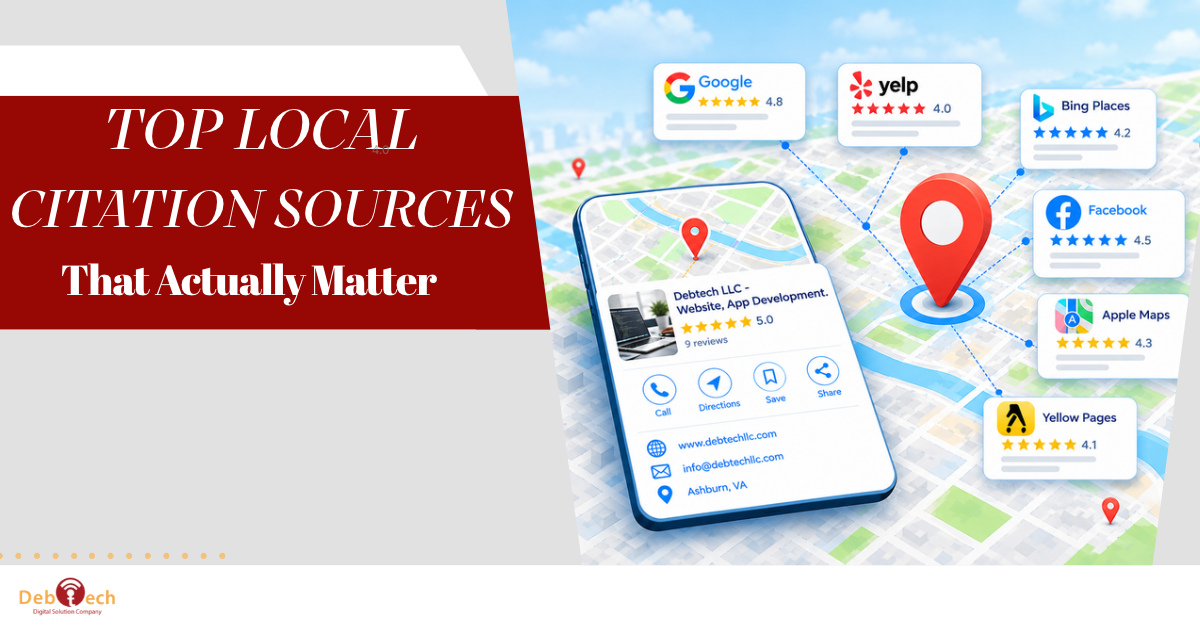
A local search campaign can lose ground before it reaches the website. If Google, Apple Maps, Yelp, and industry directories show different phone numbers, suite numbers, or business names, customers hesitate and search engines receive mixed signals. The top local citation sources are not simply the directories with the longest lists. They are the platforms that customers use, search engines trust, and your business can maintain accurately.
For a service business competing in Northern Virginia or any crowded local market, citation work should support a larger goal: helping qualified people find, trust, and contact the business. That requires disciplined listing management, not a one-time submission spree.
What a Local Citation Does for Your Business
A local citation is an online mention of a business's core details, usually its name, address, phone number, website, business category, and operating hours. It may appear on a map platform, review site, social profile, chamber directory, industry marketplace, or local publication.
Citations are not a substitute for a technically sound website, strong location pages, reviews, or useful local content. Their value is more foundational. Consistent business information makes it easier for search engines to connect your company with a real location and helps prospective customers verify that they are contacting the right business.
The details must match across the listings that matter. A business that uses “ABC Plumbing LLC” on one profile, “ABC Plumbing” on another, and an old address on a third creates unnecessary cleanup work. Minor formatting differences such as “Suite 200” versus “Ste. 200” are usually less serious than a wrong phone number or a duplicate listing, but consistency is still the operating standard.
Top Local Citation Sources to Prioritize First
The right citation mix depends on your industry, service area, and customer behavior. A restaurant, law firm, contractor, medical practice, and B2B software company will not benefit equally from the same directories. Start with high-visibility platforms, then add authoritative category-specific and local sources.
Google Business Profile
Google Business Profile is the first listing to verify because it directly supports visibility in Google Maps and local search results. Complete every relevant field: primary and secondary categories, services, service areas, hours, photos, business description, appointment options, and accurate contact information.
Do not treat it as a set-it-and-forget-it asset. Holiday hours, office moves, new services, and unanswered reviews can all affect customer confidence. For businesses with multiple locations, each location needs its own properly managed profile and landing page strategy.
Apple Business Connect and Bing Places
Apple Business Connect influences how customers find your company through Apple Maps, Siri, and other Apple experiences. Bing Places supports visibility across Bing search and mapping products. Neither should be ignored simply because Google generates more local search volume.
That trade-off is especially relevant for professional services and local businesses serving affluent, mobile-heavy audiences. A prospect who searches from an iPhone or asks a voice assistant for a nearby provider may never encounter your Google listing first.
Yelp, Facebook, and Nextdoor
Yelp remains influential for many consumer-facing categories, particularly home services, dining, beauty, health-related businesses, and local retail. Facebook can rank for branded searches and gives customers another place to check hours, messages, and community activity. Nextdoor can be valuable where neighborhood recommendations strongly influence purchase decisions.
These listings should reflect the same business identity, but they should not be copied word-for-word. Use each platform's available features appropriately. Add service details where customers expect them, use current photos, and assign someone to monitor direct messages and reviews.
Better Business Bureau and Local Chambers
The Better Business Bureau and legitimate local chamber directories can strengthen trust because customers recognize them as established organizations. They are often worth prioritizing for businesses that sell higher-consideration services, work with homeowners, or depend on reputation before a prospect submits a lead form.
A chamber listing is most useful when the organization is active in your market and its directory is visible in search. Joining every association solely for a citation is rarely an efficient use of time. Choose organizations where membership, referral opportunities, and local credibility have business value beyond SEO.
Industry-Specific Directories
Vertical directories frequently matter more than generic directories because they match a customer's intent. A home service company may need strong profiles on contractor and home improvement platforms. A legal practice may need legal directories. Healthcare providers should focus on respected provider directories, while B2B firms may benefit from relevant professional associations and software marketplaces.
The test is simple: would a qualified buyer realistically use this site to research or compare providers? If the answer is yes, build a complete profile. If the directory has no audience, weak moderation, or a poor reputation, a listing there may add little value and create another record to maintain.
Data Providers and Mapping Ecosystems
Some business databases distribute information to mapping products, navigation tools, voice assistants, and smaller directories. Their coverage and partnerships change over time, so businesses should not assume one submission updates every platform automatically.
For companies with old addresses, multiple locations, franchise records, or years of inconsistent listings, this layer can be useful for cleanup and monitoring. The practical priority remains the same: confirm your core profiles first, then use distribution tools or manual submissions to address meaningful gaps. Automation can save time, but it does not replace quality control.
Build Citations From a Single Source of Truth
Before claiming listings, create a master business record. This is the approved version of your name, address, local phone number, website URL, hours, description, categories, logo, and key service information. Keep it in a shared document that marketing and operations teams can access.
This step prevents a common failure point: a new website, campaign landing page, or office update goes live while old directory records remain untouched. The business looks disorganized even when the underlying service is excellent.
For service-area businesses that do not receive customers at their office, follow each platform's address-display rules carefully. Do not publish an address simply to appear in more locations. Local SEO shortcuts that conflict with platform guidelines can lead to suspended profiles and lost visibility.
How to Audit Existing Listings Before Adding New Ones
More citations are not always better. First, search for your company name, phone number, previous business name, and former address. Document duplicate records, outdated information, unclaimed profiles, and listings that point to broken pages.
Then classify the findings by business impact. Fix wrong information on Google, Apple, Bing, major review platforms, and high-traffic industry directories before spending effort on low-value sites. If an old listing ranks for your brand name or sends calls to a disconnected number, it becomes an immediate priority.
A useful audit should also check whether each profile supports the customer journey. Can a prospect see the right category, service area, hours, photos, and contact method? Does the website URL lead to a relevant page that works well on mobile? Citation accuracy and conversion performance belong in the same conversation.
Common Citation Mistakes That Waste Local SEO Effort
The most expensive mistake is treating citations as a volume game. Mass submissions can create duplicates, inconsistent categories, spammy placements, and a cleanup burden that lasts longer than the original campaign.
Other recurring issues include using call-tracking numbers without a clear tracking plan, changing the business name to add keywords, ignoring customer edits on map listings, and leaving former locations active after a move. A tracking number can be appropriate when implemented correctly, but the core phone number should remain consistent where possible and reporting should be tested before changes are rolled out.
Businesses also underestimate the operational side. Someone must own listing updates when hours change, a location closes, or a new service launches. Local visibility breaks down when marketing knows about a change but the people managing listings do not.
Measure Whether Citation Work Is Producing Results
Citation performance should be measured through outcomes, not the number of completed submissions. Track branded search visibility, map impressions, direction requests, phone calls, website visits from listings, review volume, and leads attributed to local search.
For a multi-location business, evaluate each location separately. One office may need duplicate cleanup, while another needs better categories, stronger reviews, or a more relevant location page. Treating every branch as identical can hide the actual reason performance differs.
At Debtech, local SEO work is approached as part of a connected digital system: accurate listings bring the right visitor closer, while a fast mobile site and conversion-focused landing experience turn that visibility into measurable opportunity.
The best citation strategy is not the one with the largest spreadsheet. It is the one that keeps your business easy to find, easy to verify, and easy to contact when a ready-to-buy customer searches for what you do.