
Startup MVP Development Guide for Faster Launches
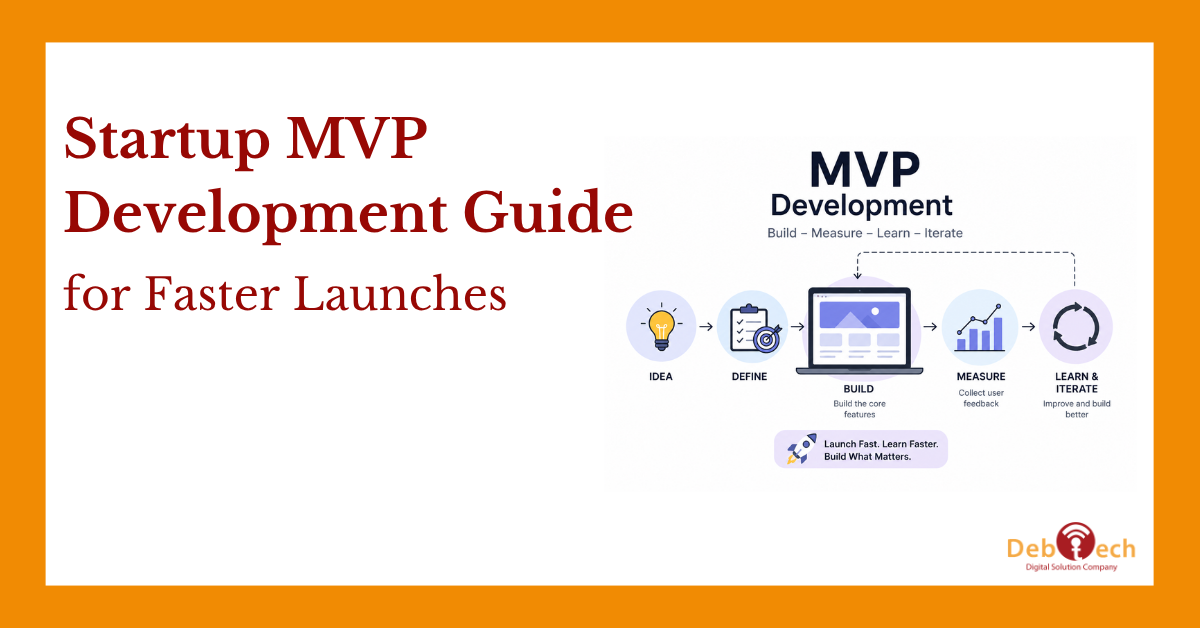
A startup MVP development guide should not begin with a feature list. It should begin with a costly business assumption: Will a specific customer pay attention, sign up, request a demo, or change behavior because this product solves a problem they already feel? Your MVP exists to answer that question quickly, with enough quality to earn credible feedback and not so much complexity that you burn months building the wrong thing.
For founders and operators, the real risk is rarely lack of ideas. It is building too broadly before the market has given you a reason to. A focused MVP creates a direct path from customer problem to usable product to measurable evidence. That evidence then informs your product roadmap, marketing message, sales process, and growth investment.
Start With the Problem, Not the Product
An MVP is not a stripped-down version of every feature you hope to offer someday. It is the smallest useful solution to one high-value customer problem. If a user can complete the core job and experience a meaningful result, the product is viable enough to test.
Start by defining the customer segment narrowly. “Small businesses” is too broad. “Independent ABA therapy providers coordinating caregiver schedules” or “local delivery operators managing same-day order dispatch” gives your team something concrete to test. The more specific the initial audience, the easier it is to identify their current workflow, points of friction, and willingness to switch.
Then write a clear problem statement: a defined user struggles with a particular task because the current process is slow, fragmented, expensive, error-prone, or difficult to manage. Avoid vague statements such as “users need a better experience.” Better than what? For whom? What does failure cost them?
A useful test is whether you can describe the promised outcome in one sentence. For example: “Help property managers receive and route maintenance requests without relying on text-message chains.” That statement identifies the user, the broken process, and the business value.
Validate Demand Before Full Development
Founders often assume validation means asking people whether they like an idea. It does not. Most people will politely say yes to a concept and never use it. Strong validation looks for behavior, commitment, and repetition.
Before building, speak with potential users who actively deal with the problem. Ask them to walk through the last time it happened. What triggered it? How did they solve it? Which tools did they use? Where did delays, errors, or frustration occur? Specific stories reveal far more than hypothetical opinions.
Next, test your positioning with a simple landing page, a focused outreach campaign, or a clickable prototype. The goal is not volume for its own sake. You want to see whether the right audience understands the value quickly enough to take a meaningful next step, such as joining a waitlist, booking a conversation, or requesting access.
For B2B startups, a handful of strong design partners may matter more than hundreds of low-intent signups. If several ideal customers agree to test the product, provide workflow access, and give structured feedback, that is valuable market signal. If they cannot explain why they would use it instead of their current process, revisit the problem or your positioning before expanding the build.
Scope the MVP Around One Core Workflow
The most common MVP failure is feature creep disguised as strategy. Teams add dashboards, roles, integrations, reporting, notifications, payment flows, and advanced settings because each feature sounds necessary in isolation. Together, they delay launch and make it difficult to learn what is actually creating value.
Map the user’s core workflow from start to finish. For a scheduling platform, that could be creating a service request, assigning a team member, confirming the appointment, and closing the job. Every MVP feature should support a step in that flow or help the business measure whether the flow works.
A practical prioritization framework separates features into three groups:
- Must-have features let users complete the primary job.
- Supporting features reduce major friction in the primary job.
- Later features improve convenience, scale, customization, or edge-case handling.
The distinction matters. Authentication may be required. A multi-level permission system may not be. Basic order status may be required. A custom analytics suite probably is not. Your first release should be intentionally opinionated. You can handle exceptions manually while you learn whether they happen often enough to justify automation.
This is also where product decisions intersect with go-to-market. Build the features that support the promise you intend to market. If your lead message is “get a qualified service request routed in minutes,” the MVP must make that result easy to demonstrate. Do not lead with claims your product cannot yet deliver consistently.
Choose Technology for Speed, Reliability, and the Next Stage
There is no universal technology stack for every MVP. The right choice depends on the product’s core workflow, integration needs, data sensitivity, expected user volume, and future development plan. What matters is selecting a practical foundation that supports fast iteration without creating avoidable technical debt.
For many startups, a responsive web application is the right first release because it is easier to distribute, update, and test across devices. If mobile usage is central to the work itself, such as field operations, delivery coordination, or location-based tasks, a mobile-first experience may be essential from day one. The product decision should follow user behavior, not a founder’s preference for a particular platform.
Avoid overengineering early infrastructure. At the same time, do not treat quality as optional. An MVP still needs secure access, dependable data handling, clear error states, mobile usability, and performance that does not undermine trust. A slow or confusing product produces misleading feedback because users may be reacting to execution failures rather than the underlying idea.
A disciplined development partner helps protect the boundary between necessary quality and unnecessary complexity. At Debtech, that means treating product development, conversion design, and launch readiness as connected work, not separate handoffs. Your MVP should be usable by real customers and understandable to the people you need to acquire next.
Build Measurement Into the First Release
If you cannot see what users do, you cannot make sound product decisions after launch. Analytics should be part of the MVP scope, not an afterthought added once adoption stalls.
Choose a small set of metrics tied to the product’s core value. A marketplace might track completed matches. A workflow platform might track tasks created and successfully closed. A SaaS product might measure the percentage of new users who reach the first meaningful outcome within their initial session.
Do not rely on downloads, page views, or signups alone. Those numbers can look encouraging while the actual product fails to create repeat value. Better signals include activation rate, time to first value, weekly retention, completion rate for the central workflow, and qualitative feedback from users who stopped using the product.
Set an early learning cadence. Review behavior weekly, talk to users regularly, and document decisions based on evidence. If users consistently abandon one screen, investigate the reason. If they request a feature, ask what outcome they are trying to achieve before adding it. Often the requested feature is only one possible solution to a deeper problem.
Launch to a Controlled Audience First
An MVP launch should create learning, not just visibility. A controlled release to a defined group gives your team room to observe usage, address high-impact issues, and refine onboarding before broader promotion.
Start with customers who match your ideal profile and have a real reason to use the product now. Give them a clear onboarding path and a direct way to share feedback. If the product requires setup, data migration, or team adoption, do not assume users will figure it out on their own. Early onboarding is often high-touch, and that is acceptable. Manual support can expose the instructions, automations, and product improvements you will need later.
Your launch messaging should be equally focused. Explain the problem, the outcome, and the intended user. Avoid trying to appeal to every possible audience. Clear positioning improves conversion and attracts feedback from people whose needs can shape a viable business.
Know When to Iterate, Expand, or Stop
The point of an MVP is not to prove that every idea deserves more investment. It is to reduce uncertainty. Some products need iteration because users see value but struggle with the workflow. Others need repositioning because the solution works but targets the wrong segment. In some cases, the evidence shows there is not enough demand to continue.
Expansion makes sense when users reliably reach the core outcome, return without repeated prompting, and communicate a clear reason the product matters. At that point, adding adjacent workflows, integrations, automation, and growth campaigns can compound what is already working.
If engagement remains weak, resist the instinct to add more features immediately. Revisit the customer problem, the target segment, and the first-value experience. More functionality rarely fixes a product that has not earned a clear place in a customer’s workflow.
The best MVP is not the one with the fewest features. It is the one that gives your team the clearest answer about what customers value and what the business should build next. Treat each release as a business test with measurable stakes, and your next product decision will be based on evidence rather than optimism.