SEO or Google Ads: Which Drives Better Growth?
A business owner searching SEO or Google Ads is usually not asking a theoretical marketing question. They need more calls, form submissions, booked appointments, demo requests, or online sales - and they need a channel that can be measured against real business outcomes.
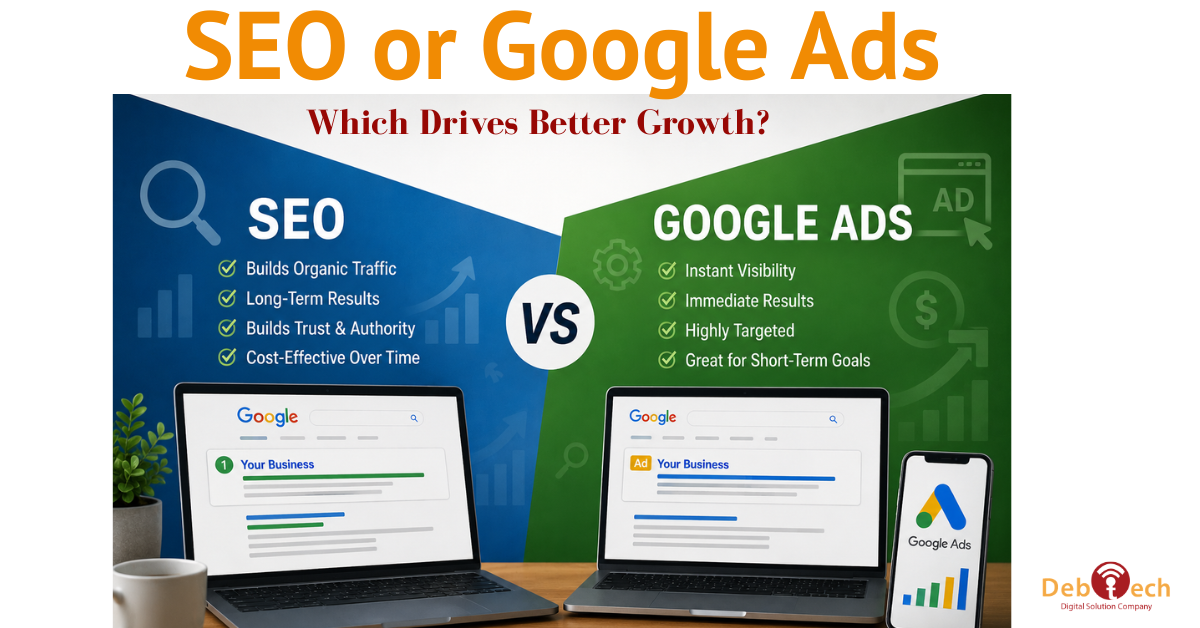
Both can produce results. The mistake is treating them as interchangeable. Google Ads buys immediate visibility for defined searches. SEO earns visibility over time by building a site and content presence Google can trust. The right choice depends on your sales cycle, search demand, website readiness, local competition, and how quickly you need qualified traffic.
SEO or Google Ads: Start With the Business Goal
The first decision should not be about a marketing channel. It should be about the job that channel must do.
If your company is launching a new service, entering a new market, filling a short-term pipeline gap, or testing whether a service has demand, Google Ads can put you in front of active searchers quickly. A well-structured campaign also gives you fast feedback on the terms, offers, locations, and landing page messages that drive action.
If your business needs a durable source of qualified leads and wants to reduce dependence on paid traffic over time, SEO deserves serious investment. Strong rankings can continue producing inquiries long after a page is published and optimized. That does not make SEO free. It requires technical work, content, local optimization, authority building, and ongoing performance management. But its value compounds when executed correctly.
For many small and midsize businesses, the best answer is not one or the other. It is a coordinated plan where paid search captures immediate opportunity while SEO builds a stronger long-term acquisition engine.
What Google Ads Does Best
Google Ads is built for speed and control. You can target high-intent searches such as “emergency plumber near me,” “commercial IT support,” or “ABA therapy services,” direct the visitor to a dedicated landing page, and measure whether that click became a lead.
This makes paid search especially useful when timing matters. A local service company may need more leads this month. A B2B firm may want to support a new offering. An eCommerce business may have a seasonal category that needs visibility before organic rankings have time to develop.
Google Ads also makes testing more practical. You can compare two offers, evaluate which service keywords generate qualified inquiries, and identify geographic areas with stronger conversion rates. Those findings should inform your website copy, landing page strategy, and SEO priorities rather than remain isolated inside an ad account.
The limits of paid traffic
Paid ads stop generating traffic when campaigns stop running. That means campaign quality matters at every stage: keyword selection, negative keywords, ad relevance, location targeting, landing page experience, call tracking, and lead qualification.
A weak website can make Google Ads look ineffective when the real problem is conversion. If visitors land on a slow mobile page, cannot understand the offer, or face a vague contact form, traffic costs accumulate without producing enough revenue. More clicks will not fix a broken conversion path.
Google Ads can also become inefficient in highly competitive markets. If competitors target the same high-value searches with stronger ads and better landing pages, the solution is not automatically to spend more. It may require narrowing the target, improving the offer, strengthening conversion assets, or shifting budget toward terms with clearer intent.
What SEO Does Best
SEO is a system for earning visibility when prospective customers search for the problems you solve. It includes technical site health, mobile usability, page structure, local relevance, service content, internal linking, search intent alignment, and reputation signals.
Its strongest advantage is cumulative value. A page that ranks for a commercially relevant query can generate leads repeatedly without requiring a payment for every visit. As your site develops more relevant pages and stronger authority, it can own more of the customer journey - from early research through ready-to-buy searches.
For businesses serving Northern Virginia and the broader DC metro area, local SEO can be particularly valuable. People frequently search with location-based intent, whether they type a city name or simply expect Google to understand where they are. A well-managed local presence helps your business appear when nearby customers are actively evaluating providers.
The limits of SEO
SEO is not an instant lead switch. New websites, competitive industries, and sites with technical weaknesses often need time before rankings improve meaningfully. Results can also be constrained by limited service-page depth, duplicate content, poor site architecture, weak reviews, or a website that does not clearly demonstrate expertise.
It is also possible to rank and still miss revenue goals. A page may attract informational traffic from people who are not ready to buy. That is why SEO strategy must prioritize intent, not vanity metrics. Ranking for a high-volume keyword has little value if it does not bring the right audience or move them toward a conversion.
Compare SEO and Google Ads by Time Horizon
Google Ads is typically the better choice when your primary need is immediate market access. Once campaigns, tracking, and landing pages are ready, you can begin collecting data and generating opportunities quickly. The work then becomes improving efficiency and lead quality.
SEO is typically the better choice when your goal is to create a lasting digital asset. It takes longer to establish, but a well-built SEO foundation supports future growth across service pages, local searches, educational content, and branded demand.
The distinction is not simply short term versus long term. It is about business risk. Relying only on paid ads means your lead flow remains closely tied to ongoing media spend. Relying only on SEO can leave a growing company waiting too long for market feedback or immediate pipeline support. A balanced approach reduces both risks.
Your Website Determines Whether Either Channel Works
Search visibility gets visitors to your site. Your website decides what happens next.
Before investing heavily in SEO or Google Ads, review the conversion experience. Is the page built around a specific customer need? Does the headline clearly explain the value? Is there proof that supports the claim? Can a mobile visitor call, request an estimate, book a consultation, or complete a purchase without friction?
A generic homepage is rarely the best destination for a paid campaign. Service-specific landing pages usually perform better because the message matches the search. The same principle supports SEO: a focused page for each core service, market, or customer problem gives Google clearer relevance and gives prospects a clearer next step.
Tracking must also connect marketing activity to business outcomes. Measure more than visits and clicks. Track calls, forms, booked meetings, qualified opportunities, sales, and where possible, revenue. If a campaign produces many inquiries but few viable prospects, the issue may be targeting, messaging, qualification, or follow-up process.
When a Combined Strategy Makes Sense
The most effective search strategy often uses each channel for what it does best. Google Ads can target high-intent terms while SEO work develops the pages needed to rank for those terms organically. Paid search data can reveal which messaging earns calls and which services are worth expanding in organic content.
At the same time, SEO can improve paid performance. Faster pages, stronger service content, clearer calls to action, and better local relevance create a better experience for ad visitors. This is why disconnected vendors often produce disconnected results. The website team, SEO team, and paid media team should be working from the same conversion goals and reporting framework.
A practical sequence is to establish conversion tracking and landing page readiness first, use paid campaigns to validate demand where speed is needed, and build SEO around the services and search patterns that demonstrate genuine commercial value. That approach turns channel data into a more disciplined growth plan.
Choose Based on Readiness, Not Hype
Choose Google Ads when you need prompt visibility, have a clear offer, and can support traffic with conversion-focused landing pages and responsive follow-up. Choose SEO when you are prepared to invest in site quality, local relevance, useful service content, and sustained improvement.
If you need both immediate leads and a more resilient pipeline, combine them under one accountable strategy. Debtech LLC approaches search this way: connecting website performance, SEO, paid acquisition, and conversion tracking so each activity supports the next.
The productive question is not whether SEO or Google Ads is better in the abstract. Ask which channel can create the next measurable improvement in your customer acquisition system - then build the website, tracking, and execution process required to make that improvement count.