Landing Page vs Full Website: Which Drives Leads?
A paid campaign can send hundreds of qualified visitors to a page and still produce few leads because the destination asks them to do too much. The landing page vs full website decision is not a design preference. It determines how clearly you present the next step, how well you support search visibility, and whether your digital presence matches the way prospects actually buy.
For most growing businesses, the right answer is not one or the other. A conversion-focused website and dedicated landing pages perform different jobs. The strongest digital systems use both with clear intent.
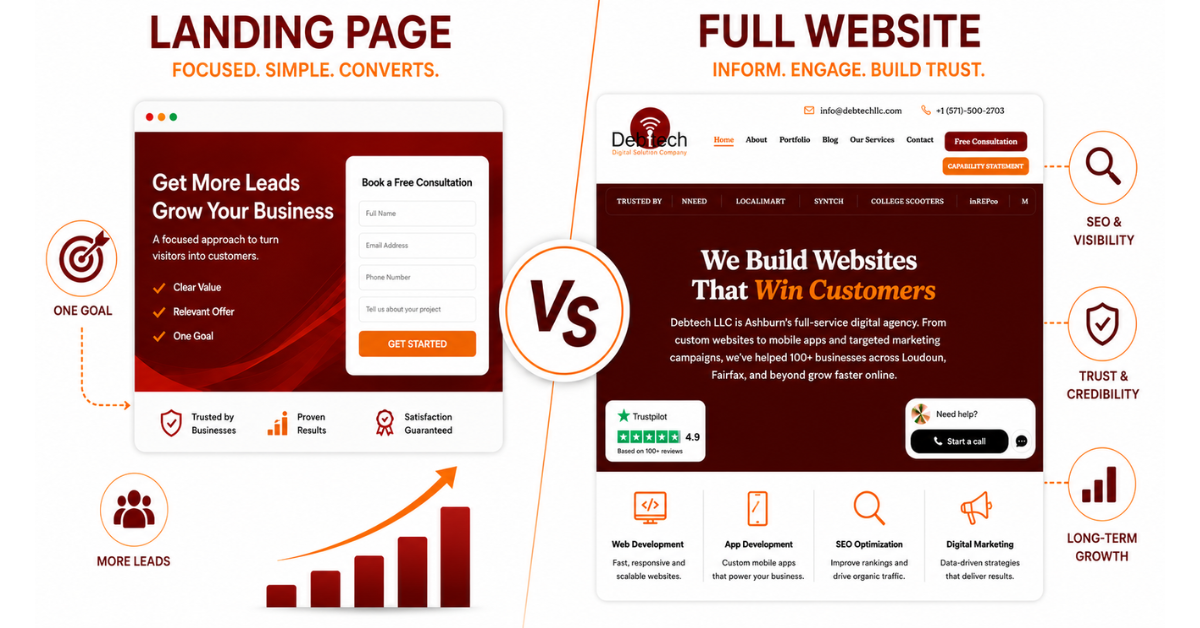
Landing Page vs Full Website: The Core Difference
A landing page is built for one audience, one offer, and one action. That action might be requesting a consultation, booking a demo, downloading a resource, or submitting a quote request. It removes competing paths so visitors can quickly understand the value proposition and decide whether to act.
A full website is the business's digital foundation. It gives prospects room to evaluate services, understand your process, review proof points, compare solutions, find location-specific information, and build confidence before reaching out. It also creates the structure search engines need to understand what you do and who you serve.
The difference comes down to focus versus depth. A landing page is designed to convert campaign traffic now. A website is designed to establish credibility, attract organic traffic over time, and support buyers who need more information before they convert.
When a Landing Page Is the Better Choice
Use a landing page when you can define a specific source of traffic and a single desired outcome. This is especially effective for PPC campaigns, targeted email promotions, event follow-up, and local service campaigns with a narrowly defined offer.
For example, a company running ads for a specific service should not send visitors to a general homepage packed with multiple services, navigation options, and broad company messaging. The visitor searched for one need. The page should answer that need directly, reinforce the same message used in the ad, and make the next step easy to complete.
A strong landing page typically includes a clear headline, a concise explanation of the outcome, relevant proof, objections handled upfront, and a prominent form or call to action. It should be mobile-first, fast to load, and built around the exact intent behind the campaign.
The biggest advantage is measurement. When one campaign sends traffic to one page with one conversion goal, it becomes easier to see what is working. You can test headlines, form length, calls to action, trust signals, and audience targeting without guessing which part of a broad website influenced the result.
Landing pages are not automatically better because they are shorter. A thin page with vague claims will underperform. If the decision carries risk or requires stakeholder approval, visitors may need more supporting detail, case evidence, FAQs, or a stronger explanation of your process. The page still has one goal, but it must earn that conversion.
When a Full Website Is the Better Choice
A full website is the better choice when prospects need to research before they contact you. That is common for B2B services, specialized providers, organizations with multiple offerings, and businesses competing in search results where trust matters as much as immediate action.
Your website should answer the questions a serious buyer asks after the first click: What do you do? Who do you help? Why should we trust you? What happens next? Can you solve our specific problem? If the site cannot answer those questions clearly, paid traffic will be harder to convert and sales teams will spend more time qualifying basic fit.
Websites also support SEO in ways a single landing page rarely can. A well-organized site gives each primary service, market, and topic a relevant place to live. This creates more opportunities to rank for commercial searches, build topical relevance, and capture prospects at different stages of the buying process.
For a local business in Northern Virginia, a full website can also support the search behavior that drives local leads. Prospects may search for a service, compare providers, look for service-area information, check credentials, and return later on a mobile device. A credible site makes that path easier.
A website should not become a digital brochure with no direction. Every core page needs a purpose, a logical conversion path, and a clear call to action. Depth is valuable only when it reduces uncertainty and moves the visitor closer to a decision.
The Conversion Trade-Offs to Understand
A landing page limits distractions, but it can also limit exploration. Some visitors are ready to submit a form immediately. Others want to review your capabilities, read about related services, or confirm that your company is established before they share their contact information. Sending every visitor to a stripped-down page can create friction for that second group.
A full website builds trust and supports discovery, but it can dilute action. Main navigation, multiple service pages, blog content, and several calls to action can give visitors too many choices. If a paid ad promises a specific solution, a general website page may create a disconnect between the ad click and the on-page experience.
The question is not whether you need more pages. It is whether each visitor has the information and direction needed for their stage of intent. High-intent campaign traffic benefits from focus. Search visitors researching a broader problem often benefit from depth.
How to Choose the Right Destination for Your Traffic
Start with the source. Traffic from a targeted Google Ads campaign has a different expectation than traffic from a branded search, a referral, or an organic article. Match the destination to what the visitor already knows and what they were promised before clicking.
Then consider the complexity of the offer. A straightforward, single-service request may work well on a dedicated landing page. A business with several interconnected services, longer sales cycles, or a more involved approval process needs a full website that can answer follow-up questions and demonstrate capability.
Your conversion goal matters as well. If the goal is one action, such as a consultation request, a landing page keeps the path direct. If the goal is to build long-term demand, establish authority, and create multiple entry points for qualified search traffic, the website should carry more of the workload.
Use these four signals to guide the decision:
- Choose a landing page for one campaign, one offer, and one primary conversion action.
- Choose a full website when trust, research, multiple services, or organic search visibility are central to growth.
- Use both when paid media needs a focused conversion path and the business also needs a credible search-ready foundation.
- Reassess the destination when conversion data shows visitors are leaving before they receive the information needed to act.
The Best Model: A Website Foundation With Campaign Landing Pages
For many small and midsize businesses, the highest-performing setup is a full website supported by dedicated landing pages. The website establishes the brand, services, authority, technical performance, and SEO footprint. Landing pages give paid campaigns and specific promotions a controlled environment built for conversion.
This approach prevents a common mistake: forcing a homepage to do the work of an ad landing page. Your homepage must serve multiple audiences, from first-time visitors to returning customers and job seekers. A campaign page can speak to one problem, one audience, and one outcome without compromise.
It also avoids the opposite mistake of building isolated landing pages with no broader proof behind them. Even when a visitor starts on a focused page, they may still look for your main site, service details, and company credentials before converting. The landing page earns attention. The website validates the decision.
At Debtech, this is how conversion-focused digital systems are approached: campaign strategy, web development, SEO, and paid acquisition should reinforce one another rather than operate as disconnected projects. A landing page that converts but leads to a weak follow-up experience wastes demand. A polished website with no campaign-specific conversion path leaves opportunities on the table.
Build for the Decision You Want Visitors to Make
Do not ask whether a landing page or a full website is universally better. Ask what the visitor needs to see before taking the next meaningful step. If you are driving focused campaign traffic, give that audience a focused page. If you need to earn trust, rank in search, and support a more considered purchase, build the website depth that decision requires.
The useful test is simple: every page should have a job. When your website builds confidence and your landing pages turn intent into action, your digital presence stops being a collection of pages and starts functioning like a growth system.