
Headless Versus WordPress for Business Growth
A slow page after a paid ad click is not a design problem. It is a revenue leak. That is why the headless versus WordPress decision deserves more than a technology debate. Your website must support the way your business attracts traffic, converts leads, publishes content, and adapts when priorities change.
For many businesses, WordPress is the right answer. For others, a headless architecture creates the speed, flexibility, and multi-channel control their growth plan demands. The mistake is treating either option as automatically superior. The right choice depends on what your digital system needs to accomplish next.
What WordPress Actually Gives Your Business
Traditional WordPress combines the content management system and the website presentation layer in one platform. Your team creates a page, adds images and copy, publishes it, and WordPress delivers the finished page to the visitor. It is a familiar operating model that supports marketing teams well.
For a local service business, professional firm, or growing company that needs a conversion-focused website, landing pages, location pages, blog content, forms, and clear calls to action, WordPress can be highly effective. It gives nontechnical users the ability to update content without creating a development bottleneck every time an offer changes or a new service launches.
WordPress also has a mature ecosystem. With the right build and disciplined plugin management, it can support search optimization, lead capture, ecommerce, analytics, accessibility improvements, and marketing integrations. The key phrase is “with the right build.” A heavily patched template with too many plugins is not the same as a strategically engineered WordPress website.
Traditional WordPress is often the strongest fit when speed to market, content publishing, and operational simplicity are the priorities. It is especially practical for organizations that do not need the same content delivered across a website, mobile app, customer portal, digital kiosk, and other interfaces.
How Headless Architecture Changes the Model
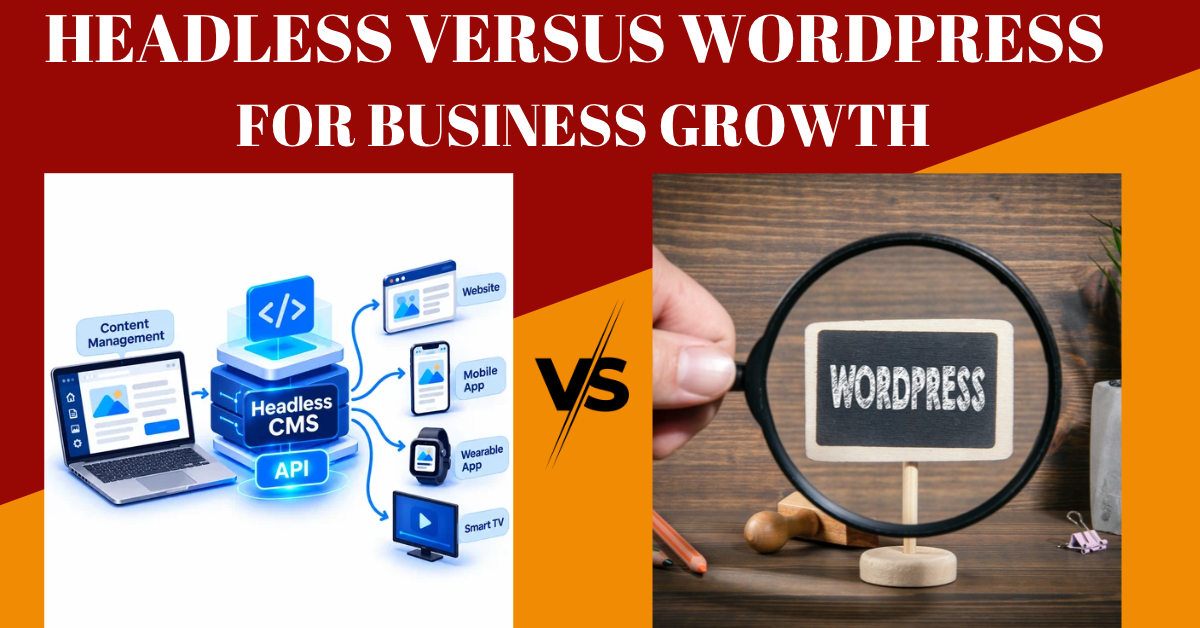
A headless website separates the content management system from the front-end experience visitors see. The CMS remains the place where your team manages pages, articles, products, or media. The “head,” or front end, is built separately using modern development frameworks and pulls content from the CMS through an API.
This separation gives development teams more freedom over performance, design behavior, and how content appears across different channels. A single content source can feed a marketing website today and support a mobile application or other digital product later. For organizations with complex requirements, that flexibility can be valuable.
Headless does not mean abandoning WordPress. Headless WordPress is a common setup: WordPress handles content management, while a separate front end delivers the user experience. This is why the phrase headless versus WordPress can be misleading. In some cases, the real decision is traditional WordPress versus headless WordPress.
The business case for headless is strongest when your website is becoming part of a larger digital operation. Think of a brand with high traffic, frequent campaign launches, personalized user journeys, complex integrations, or plans to distribute the same content across several customer touchpoints. In those cases, separating the architecture can create useful room to grow.
Headless Versus WordPress: The Business Trade-Offs
The decision should begin with measurable goals, not developer preference. Faster performance, stronger organic visibility, easier publishing, lower maintenance risk, better lead conversion, and future application requirements can all be valid goals. They do not always point to the same architecture.
Performance and conversion
Headless sites can be extremely fast because the front end can be optimized independently of the CMS. Better page speed can improve mobile usability, reduce abandonment, and support stronger performance from SEO and paid traffic. That matters when you are spending money to put qualified visitors on a landing page.
But headless is not a shortcut to fast results. Poorly written front-end code, oversized media, or weak technical implementation can still produce a slow experience. Likewise, a properly developed WordPress site can achieve excellent performance. The useful question is not which platform is faster in theory. It is whether your actual website has a clear performance standard and the engineering plan to meet it.
SEO and content control
Both approaches can support strong SEO. Search engines evaluate useful content, page quality, crawlability, user experience, technical signals, and authority. Neither WordPress nor headless automatically earns rankings.
Traditional WordPress often makes day-to-day SEO operations easier for internal marketing teams. Publishing service pages, optimizing metadata, updating local content, and maintaining a content calendar can be handled in a familiar interface. That operational speed is a real advantage for businesses competing in local search markets.
A headless site can also perform very well in search, but it requires more deliberate technical planning. Server-side rendering, structured data, canonical tags, redirects, XML sitemaps, metadata controls, and image optimization must be built and maintained correctly. If the publishing workflow makes small SEO changes harder, the architectural advantages may be offset by slower marketing execution.
Flexibility and integrations
Headless is built for flexibility. If your website needs to connect deeply with proprietary software, customer systems, product data, or a mobile app, a decoupled setup can reduce constraints. It gives developers greater control over the front-end experience and makes it easier to reuse content beyond the main website.
For many small and midsize businesses, however, that level of flexibility is unnecessary. A conversion-focused WordPress site with the right integrations can handle lead generation, ecommerce, appointment workflows, email capture, analytics, and advertising attribution without adding architectural complexity that does not produce a business return.
Governance, maintenance, and accountability
Traditional WordPress puts content and presentation in one environment. That can make updates straightforward, but it also requires ongoing attention to plugin quality, updates, security practices, backups, and performance monitoring. Neglect is what creates many WordPress problems, not WordPress itself.
Headless reduces reliance on the traditional WordPress front end, but it introduces a more technical stack. Your organization needs clear ownership for the CMS, front-end application, hosting environment, deployments, integrations, and monitoring. A headless website can be a high-performing asset, but only if the team responsible for it has a defined process for maintaining it.
When Traditional WordPress Is the Better Call
Choose traditional WordPress when your primary need is a high-converting marketing site that your team can manage efficiently. It is usually the practical choice for service businesses that need strong local SEO, campaign landing pages, ongoing content, lead forms, and a polished mobile experience without turning the website into a software project.
It also makes sense when marketing teams need to move quickly. If your company regularly updates offers, publishes case studies, adds service areas, tests messaging, or supports paid campaigns with new landing pages, a well-structured WordPress implementation keeps those changes accessible.
This does not mean settling for generic templates. The right WordPress build should be mobile-first, conversion-focused, secure, and technically clean. It should connect to your marketing measurement so you can see which channels, pages, and actions are generating qualified leads.
When Headless Is Worth the Added Complexity
Headless becomes more compelling when the business has a real need for it. That may include a content-heavy organization serving multiple digital channels, a company building web and mobile products around the same data, or an enterprise with advanced integration and performance requirements.
It can also be appropriate when an existing website is restricting growth. If a business is constantly working around platform limitations, struggling with performance under high traffic, or attempting to unify fragmented content across several customer experiences, a headless model may provide a better long-term foundation.
The threshold should be strategic, not aspirational. Building headless because it sounds modern is a poor reason. Building it because it supports a defined roadmap, measurable performance target, and broader digital ecosystem is a strong one.
Start With the Customer Journey, Not the Platform
Before selecting an architecture, map what happens from first click to completed conversion. Identify where traffic comes from, which pages carry the most commercial weight, what data must pass between systems, who publishes content, and where the current experience creates friction. This is the work that turns a platform choice into a growth decision.
For most businesses, the best website is not the one with the most advanced technical label. It is the one that loads quickly, makes the next step obvious, supports search visibility, gives marketing teams control, and produces reliable data for better decisions. Build around that standard, and the technology will have a clear job to do.