
Custom Laravel Development vs. Off-the-Shelf Software: Which Is Right for Virginia Businesses in 2026?
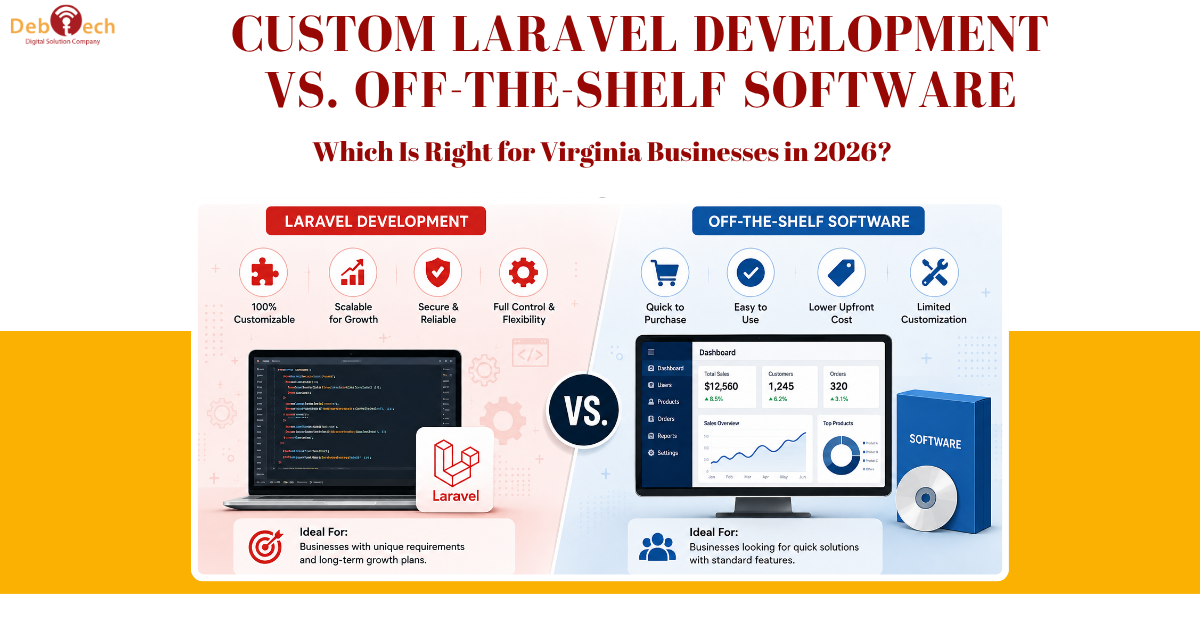
Here's an unpopular truth about business software: the cheapest option upfront isn't always the cheapest option in the long run.
I've watched businesses pick a ready-made platform because it looked affordable and easy to launch — and honestly, that's often the right call. But problems tend to surface later. The business grows, the workflow gets more complex, and the software that once felt convenient starts getting in the way.
That's where custom Laravel development enters the conversation.
The real question isn't "Is custom software better than off-the-shelf software?" That's too simple, and it's the wrong question. The better one is: does the software actually fit the way your business works?
At Debtech LLC in Ashburn, we help Virginia businesses answer exactly that. Some genuinely need custom software. Others are better off sticking with an existing platform and keeping their money.
Here's how I'd think through the decision in 2026 — including where I've seen it go right, where I've seen it go wrong, and what Virginia businesses should consider before investing in custom software development.
What Is Off-the-Shelf Software?
Off-the-shelf software is exactly what it sounds like: a ready-made product you can start using without building anything from scratch.
Think popular CRM systems, accounting platforms, project management tools, e-commerce software, and other business applications designed to serve a broad customer base. You pay for the software, configure it, and get moving.
The biggest advantage is speed.
If you're a small business with straightforward requirements, you may not need custom software at all. A small consulting firm that needs to store client information, track leads, and send follow-up emails will usually do just fine with a standard CRM.
My advice in that situation is simple: don't build custom software for the sake of having custom software.
It should solve a real business problem — not serve as an expensive way to do something a $50-a-month tool already handles.
The trouble starts when a business asks the software to do things it was never really built to do.
Where I've Seen Off-the-Shelf Software Go Wrong
A few years ago, we worked with a Northern Virginia logistics operation running five separate tools: one for customer management, one for shipment tracking, one for employee communication, one for invoicing, and a spreadsheet nobody officially owned but everybody depended on.
Each tool worked fine in isolation.
The damage was in the gaps between them.
Dispatch staff were re-entering the same shipment details into three systems by hand. Invoicing was running a day behind because someone had to manually reconcile delivery confirmations against completed jobs.
When we sat down with their operations manager and actually timed it, her team was spending roughly 12–15 hours a week just moving information between platforms — not doing logistics work, just data entry that existed because the systems didn't talk to each other.
That's not a hypothetical.
That's the pattern I see over and over: small, tolerable friction that quietly compounds into a second, unofficial job description for half the staff.
This is one of my strongest opinions on business software:
Five "cheap" tools can become far more expensive than one well-built system.
The cost isn't just the subscription fees. It's the payroll hours spent babysitting the gaps between them.
What Is Custom Laravel Development?
Laravel is a PHP framework used to build custom web applications.
The technical definition is useful, but here's what actually matters to a business owner: Laravel gives developers the flexibility to build software around your workflow, instead of asking your team to adapt to someone else's.
That's the real value of custom Laravel development.
Instead of starting with a fixed list of features and asking, "How can we make our business fit this platform?", you can start with the business problem and ask, "What should the software actually do?"
For that same logistics company, the fix wasn't more tools — it was one central system built around what they actually did all day:
- Customer and account management
- Shipment tracking
- Automated notifications
- Employee dashboards
- Custom reporting
- Invoice management
- Role-based access
- Third-party integrations with their existing GPS and fuel-card vendors
Within a few months of launch, that 12–15 hours a week of manual reconciliation dropped to under two — mostly exception-handling, not routine re-entry.
The software started supporting the way the company already worked, instead of the other way around.
Custom Laravel Development vs. Off-the-Shelf Software
Here's the simplest way I can put it.
Off-the-shelf software asks: "Which of our existing features can solve your problem?"
Custom software asks: "What do you actually need?"
That single difference in framing shapes almost everything else — cost, implementation speed, flexibility, integrations, scalability, and how much your team ends up compromising.
Choose Off-the-Shelf Software If:
- Your business processes are standard
- You need to launch quickly
- Your budget is limited
- Your team can reasonably adapt to existing workflows
- An existing platform already handles most of your requirements
- Your software needs aren't likely to become significantly more complex
For many small businesses, this is the smarter choice.
There's nothing wrong with using software that already works.
Consider Custom Laravel Development If:
- Manual workarounds have become normal, not exceptional
- Multiple business systems need to communicate and don't
- Your workflows are genuinely different from industry-standard processes
- Existing platforms require expensive customization
- Your business relies on specialized workflows
- You need custom dashboards, reporting, permissions, or automation
- Your software requirements are clearly becoming more complex
- Your current technology stack is creating operational bottlenecks
My hot take: if your employees have built an unofficial "manual" for working around your software, the software is already part of the problem.
And here's a sharper version of that test — if you're constantly paying for integrations just to make your tools talk to each other, you may not have a software problem.
You may have an architecture problem.
When people lean on spreadsheets, group chats, copy-pasted data, and manual double-checking just to keep a system running, that's rarely just a training issue.
It's often a fit issue.
Custom Laravel Development vs. Off-the-Shelf Software: Key Differences
|
Factor |
Custom Laravel Development |
Off-the-Shelf Software |
|
Initial Cost |
Higher |
Lower |
|
Implementation Speed |
Slower |
Faster |
|
Customization |
Highly flexible |
Limited to available features |
|
Workflow Fit |
Built around business processes |
Business adapts to platform |
|
Integrations |
Built around specific requirements |
Depends on available integrations |
|
Scalability |
Can evolve with the business |
Depends on platform capabilities |
|
Ownership & Control |
Greater control |
Primarily controlled by vendor |
|
Maintenance |
Requires ongoing development |
Generally managed by provider |
|
Best For |
Unique or complex workflows |
Standard business requirements |
There isn't a universally better option.
The right choice depends on what your business needs from its software today — and where those needs are heading.
When Should a Virginia Business Consider Custom Software?
For many Virginia businesses, the decision comes down to how much their current software is helping — or getting in the way of — daily operations.
If your team is spending significant time moving information between systems, building spreadsheet workarounds, manually reconciling records, or paying for multiple integrations simply to keep essential platforms connected, that's worth investigating.
The same applies if your business has workflows that are genuinely different from the standard processes most commercial software is designed to handle.
For example, a business may need:
- A specialized customer portal
- Custom employee dashboards
- Complex approval workflows
- Automated internal processes
- Centralized data from multiple platforms
- Industry-specific reporting
- Custom permissions and user roles
- Integrations with existing business systems
Custom software isn't automatically the answer.
But for a growing Virginia business whose processes are becoming more complex, custom software development can be worth considering when the cost of working around existing tools starts becoming greater than the cost of solving the underlying problem.
Is Custom Laravel Development More Expensive?
Upfront, usually yes.
A custom application requires planning, design, development, testing, deployment, and ongoing maintenance. You're paying for something built specifically for your business, not renting a slice of something built for thousands of businesses.
But the first invoice doesn't tell the whole story.
This is where many software comparisons go wrong.
Take a company running five subscriptions at roughly $150–$400 each per month. On paper, that's maybe $1,500–$2,000 a month — cheap compared with a custom software project that could cost tens of thousands of dollars depending on scope and complexity.
But once you add:
- Premium-tier upgrades to unlock features you actually need
- Integration or middleware costs to connect tools that don't natively communicate
- Consultant or agency fees to configure and maintain those integrations
- Employee hours spent on manual data entry and reconciliation
- The cost of errors caused by systems failing to sync
- Missed invoices or duplicate records
- Time spent switching between multiple platforms
...that "cheap" $1,500 a month can represent a much larger real cost once you price in labor, integrations, and mistakes.
The exact numbers will vary from business to business.
That's why I always push clients toward total cost of ownership, not sticker price.
Ask Yourself:
- What are we paying for software right now, across every tool?
- What extra tools have we added because the main platform couldn't do something?
- How much employee time goes into manual work between systems?
- What errors happen because our systems don't communicate properly?
- How much are integrations and third-party services costing us?
- What would it cost to solve the underlying workflow problem?
- What would the business gain if employees could spend those hours on higher-value work?
Sometimes custom software is the more expensive option, full stop.
A stable five-person business with simple, unchanging needs will rarely recoup a custom build.
Sometimes, however, a custom application can become financially worthwhile when it eliminates enough recurring costs and operational inefficiencies.
The honest answer depends on your numbers, not on which side of the argument sounds better in a sales pitch.
Think About Where Your Business Will Be in Three Years
This is where a lot of companies make the wrong call: they choose software based only on what they need today.
What happens when your 10-person team becomes a 50-person team?
What happens when you add new service lines, more locations, more customers, or new integrations?
A simple CRM that works fine now may become restrictive under real growth. An e-commerce platform may become difficult to work with when your sales model changes.
Custom Laravel development gives you the ability to build a software foundation around your business and evolve it over time.
But that doesn't mean building every conceivable feature before launch.
I'd actually argue against that.
Start with the features that solve your biggest, most expensive problems. Build the foundation properly. Then add functionality as the business earns it.
For most growing Virginia companies we work with, "build the foundation first, add features as you go" beats "try to predict every requirement before version one ships" — every time.
When You Should NOT Choose Custom Laravel Development
Here's the part that often gets skipped when a software company is trying to sell you a custom project.
You probably shouldn't choose custom Laravel development if:
- Your business processes are simple and standard
- An existing platform already handles your requirements well
- You need something immediately and don't have time for development
- Your requirements are unlikely to change
- Your team is comfortable with the current software
- The cost and responsibility of ongoing development don't make sense for your business
Sometimes the best software decision is the least complicated one.
If a reliable off-the-shelf platform solves your problem without forcing your employees into daily workarounds, use it.
There's no prize for having custom software.
How Should Your Business Choose Between Custom and Off-the-Shelf Software?
Before choosing any software, answer these questions honestly:
- Are our business processes standard, or genuinely specific to how we operate?
- How often do employees rely on manual workarounds just to get through the day?
- How many different platforms are we running right now?
- Do those platforms actually communicate with each other — or does a person do that job manually?
- Are our requirements likely to get more complex over the next few years?
- Are we paying for features we don't use while missing features we actually need?
- How much employee time are we losing to repetitive administrative work?
- What are our current software, integration, and maintenance costs?
- Would consolidating into one platform genuinely improve how we operate — or would it simply feel nice?
Answering those honestly will tell you more than comparing two price tags ever could.
If you're weighing this decision, talk it through with a development partner who's actually seen both outcomes play out — not just one who sells custom builds.
Sometimes an existing product, properly configured, solves the problem in a week.
Sometimes forcing that product to fit creates years of quiet frustration.
A good partner tells you which situation you're in, even when the honest answer is "you don't need custom software yet."
Why Laravel Can Be a Strong Choice for Custom Business Applications
Laravel is particularly useful when a business needs more than a collection of standard software features.
A custom Laravel application can be built around requirements such as:
- Role-based dashboards and permissions
- Custom business logic
- Automated workflows
- Custom reporting
- Third-party API integrations
- Centralized business data
- Internal management tools
- Specialized customer portals
- Employee portals
- Business-specific approval processes
The point isn't that Laravel is automatically better than every other technology.
It isn't.
The point is that a mature development framework gives your development team the flexibility to build an application around your actual requirements rather than forcing your business into a fixed software model.
For businesses considering custom Laravel development services, that's the part worth paying attention to.
The technology matters.
But the business problem you're solving matters more.
Custom Software Development for Virginia Businesses: What Really Matters
For a Virginia business, choosing custom software shouldn't begin with the question, "Why Laravel?"
It should begin with:
"Where is our current software costing us time, money, or opportunities?"
Maybe it's a manual process that takes hours every week.
Maybe your employees are entering the same information into multiple systems.
Maybe your customers are using a portal that doesn't reflect how your company actually works.
Maybe your team has built a collection of spreadsheets and workarounds that nobody wants to admit has become critical infrastructure.
Those are the problems worth investigating.
Once you understand the problem, you can decide whether custom Laravel development, an existing platform, better integrations, or something else is the right solution.
The Bottom Line for Virginia Businesses
There's no universal winner here, and anyone selling you one is selling you something else too.
If you need basic functionality fast, commercial software is the logical move — full stop.
But if you're regularly fighting your software's limits, stitching together tools that don't communicate, manually moving data between platforms, and expecting significant growth, custom Laravel development is worth serious consideration.
Start with what your company actually needs, not what's cheapest on paper this month.
Map your workflows.
Find the bottlenecks.
Watch what your team does manually and time it.
Then calculate what your current setup is really costing you — not just in dollars, but in hours.
You might find out you don't need another subscription.
You might find out you need software that was actually built for the way your business works.
Still Not Sure? Let's Figure It Out Together
Cost matters.
Speed matters.
Flexibility matters.
And getting this decision wrong is an expensive mistake to walk back.
At Debtech LLC in Ashburn, we help Virginia businesses cut through the noise and figure out what they actually need — whether that's custom Laravel development, custom software development, a better-configured CRM, or something else entirely.
No pressure to build custom just because we can.
We'll look at your workflows, your current tools, and the problems your team is actually facing before recommending a direction.
Book a free consultation with Debtech LLC today, and let's figure out whether custom software is actually the right call for your business.
Frequently Asked Questions
Is custom Laravel development better than off-the-shelf software?
Not always — and anyone who tells you otherwise is trying to sell you something.
It depends on how well your current tools actually fit your workflows. If a standard platform handles what you need without daily workarounds, off-the-shelf software is usually the smarter, faster, cheaper choice.
Custom Laravel development earns its cost when your business has genuinely outgrown what ready-made software can do.
Is custom software more expensive?
Upfront, usually yes.
You're paying for planning, design, development, testing, deployment, and maintenance rather than simply paying a monthly subscription.
But that first invoice isn't the full picture. Once you account for total cost of ownership — stacked subscriptions, integration fees, consultants, employee hours lost to manual workarounds, and errors caused by disconnected systems — off-the-shelf software can sometimes end up costing more over the long term than a well-built custom application.
When should a business choose custom Laravel development?
Consider custom Laravel development when manual workarounds have become part of the normal routine, when multiple systems need to communicate and don't, or when your existing platform requires expensive add-ons just to perform essential business functions.
It can also make sense when your workflows are a genuine competitive advantage — something a generic platform was never designed to protect or support.
How long does a custom Laravel development project typically take?
It depends heavily on scope, complexity, integrations, design requirements, testing needs, and the number of workflows involved.
A focused first version — covering your highest-impact workflows rather than every feature you can imagine — can often be delivered faster than a large, all-in-one system.
Trying to launch everything at once is usually what turns a reasonable timeline into an unreasonable one.
Is Laravel suitable for business applications?
Yes.
Laravel is a mature PHP framework used to build flexible web applications. It can be well suited to systems that need custom business logic, role-based dashboards, custom reporting, integrations across multiple platforms, and specialized workflows.
The important question isn't whether Laravel can technically build something.
It's whether Laravel is the right technology for the specific business problem you're trying to solve.
Can Laravel integrate with existing business software?
Yes.
A custom Laravel application can be designed to communicate with other business systems through available APIs and integrations.
The exact possibilities depend on the platforms involved, the APIs they provide, authentication requirements, and the level of access available.
Can custom Laravel software scale as a business grows?
It can be designed with future growth in mind, but scalability depends on the application's architecture, infrastructure, database design, integrations, and ongoing maintenance.
The goal shouldn't be to build every possible feature from day one.
A better approach is to establish a solid technical foundation, launch the highest-value functionality first, and expand the system as the business grows.