
A B2B Conversion Example That Builds Pipeline
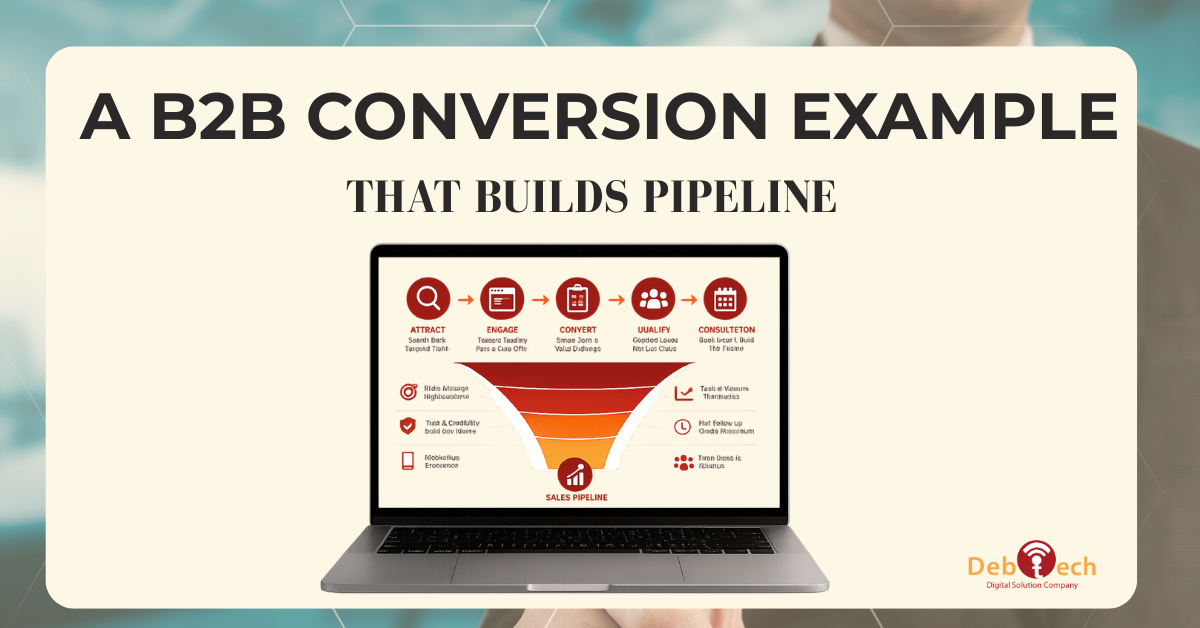
A B2B conversion example is more useful when it follows the actual path from attention to a qualified sales conversation. Traffic alone does not build pipeline. A prospect must understand the offer, trust the provider, see a clear next step, and receive timely follow-up after taking action.
That is where many growth-stage businesses lose opportunities. They run paid campaigns to a general website page, ask visitors to fill out a long contact form, and then measure success by clicks or raw lead volume. The result is often expensive inquiries, weak sales conversations, and no clear explanation of what is holding performance back.
The better approach is to treat conversion as a connected digital system. The website, landing page, ad message, form, tracking, and sales follow-up each have a job. If one breaks, the full acquisition process underperforms.
A B2B Conversion Example From Click to Consultation
Consider a hypothetical B2B technology services firm that sells managed cybersecurity support to midsize organizations. Its ideal buyer is an operations leader or IT director at a company with 50 to 500 employees. The service is valuable, but the decision is not impulsive. Prospects need proof, clarity, and confidence before agreeing to talk.
The company has been running search ads for terms related to cybersecurity assessments and compliance support. The ads get clicks, but most visitors leave the website without contacting the company. The few leads that do arrive vary widely in fit, which causes the sales team to spend time on conversations that never reach a real opportunity.
The first problem is not necessarily the ad campaign. It is the disconnect after the click.
A general services page may include several offerings, a broad company overview, team bios, and a standard "Contact Us" button. That page can be appropriate for branded traffic or visitors who are already comparing providers. It is less effective for a search visitor who has one urgent question: can this company solve my specific risk or compliance problem?
The conversion strategy starts by building a dedicated landing page around the search intent. Instead of sending visitors to a broad website page, the ad for "cybersecurity assessment for financial services" leads to a page focused on that exact need.
The page opens with a direct value proposition: identify security gaps, prioritize remediation, and prepare for the compliance requirements that affect the buyer's business. It does not lead with generic statements about innovation or technology expertise. It explains the business outcome first.
Below that opening, the page establishes credibility with relevant experience, a concise explanation of the assessment process, and the practical deliverables a prospect can expect. A short qualification form offers a clear exchange of value: request an assessment consultation or receive a readiness review.
That change matters because the landing page now continues the conversation started by the ad. The keyword, ad copy, headline, proof points, and call to action all address the same buyer concern.
Why This B2B Conversion Example Works
The conversion does not happen because the page uses a more aggressive button color or adds a countdown timer. In B2B, especially for higher-consideration services, the most effective improvements usually come from message alignment and reduced friction.
First, the offer matches the stage of the buyer journey. A prospect researching security requirements may not be ready to request a full proposal. They may be ready to discuss an assessment, review a checklist, or validate whether their current approach exposes the business to risk. Asking for the right-sized commitment earns more qualified responses.
Second, the page gives visitors enough information to make an informed next move without overwhelming them. Decision-makers want to know who the service is for, what problem it addresses, how engagement works, and why the provider is credible. They do not need a wall of technical language before they can request a conversation.
Third, the form qualifies without becoming an obstacle. The company asks for name, work email, company, role, and a brief description of the current challenge. It avoids asking for information that the sales team can gather later, such as detailed budget ranges, full system inventories, or lengthy project specifications. Every unnecessary field can reduce completion rates.
There is a trade-off. A very short form may produce more leads but create more work for sales. A longer form can filter out poor-fit prospects but may discourage strong prospects who are early in their research. The right balance depends on sales capacity, deal complexity, traffic quality, and the cost of each lead.
The System Behind a Stronger Conversion Rate
A high-performing B2B landing page is only one part of the process. The firm also needs accurate tracking. Each form submission should be recorded as a conversion, but it should not be treated as the final measure of success.
The marketing team tracks the source of every inquiry, including the campaign, keyword theme, ad group, landing page, and device type. The sales team then marks whether the lead was contacted, qualified, scheduled for a meeting, or advanced to an opportunity. This closes the gap between marketing activity and revenue potential.
Without this feedback loop, paid media optimization can move in the wrong direction. A campaign that generates inexpensive form fills may look successful in an advertising platform while producing no qualified opportunities. Another campaign may generate fewer leads at a higher acquisition cost but consistently reach decision-makers who book meetings and enter the pipeline.
That is why conversion reporting should include more than website submissions. Useful operating metrics include landing page conversion rate, qualified lead rate, consultation booking rate, speed to first response, opportunity creation rate, and pipeline value by source. Not every business needs a complex dashboard on day one, but every business needs a way to identify which channels produce real commercial value.
Mobile performance also deserves attention. Many B2B buyers research on a phone between meetings, while traveling, or after receiving an internal request. If the page loads slowly, the form is difficult to use, or the call to action is buried, a qualified visitor may leave before the company has a chance to earn the conversation. Mobile-first design is not a cosmetic preference. It affects conversion directly.
Improving the Example After Launch
The first version of a landing page is an informed business decision, not a final answer. After enough qualified traffic arrives, the company can identify where prospects hesitate.
If visitors reach the page but rarely scroll, the opening message may be too broad or too technical. If visitors read the service details but abandon the form, the offer may not feel valuable enough, or the form may ask for too much. If form submissions are high but consultations are low, the issue may be lead qualification, sales response time, or a mismatch between the promise in the ad and the discussion that follows.
Testing should focus on meaningful variables. A company might compare a consultation offer against a readiness assessment, test industry-specific proof points, or create separate pages for different buyer roles. It can also refine its ad targeting based on which search terms consistently produce qualified conversations.
Avoid changing everything at once. If the headline, offer, form, audience, and ad copy all change in the same week, it becomes difficult to know what improved performance. Controlled iteration creates accountability and makes future investment decisions easier.
For local and regional service businesses, geographic relevance can also improve results. A landing page or campaign aimed at Northern Virginia decision-makers may address local operating conditions, nearby service coverage, or the need for an accountable partner who understands the DC metro market. That specificity should be useful, not forced. Buyers respond to relevance when it solves a real concern.
Turning the Model Into Your Own Conversion Process
This model applies beyond cybersecurity. A software development firm can build a campaign around a legacy application modernization assessment. A professional services company can offer a focused operational review. A B2B manufacturer can use a product-specific request form that helps buyers identify the right solution before a sales call.
The key is to define one audience, one high-value problem, and one next step. Then connect the acquisition path from ad or search result through landing page, form submission, and follow-up. Debtech approaches this work as an integrated digital system because isolated fixes rarely produce dependable growth.
Start with the question your best prospects are already asking. Build the page that answers it clearly, make the next action easy, and measure what happens after the form is submitted. That is how a website begins doing more than collecting traffic - it starts creating sales opportunities your team can act on.